
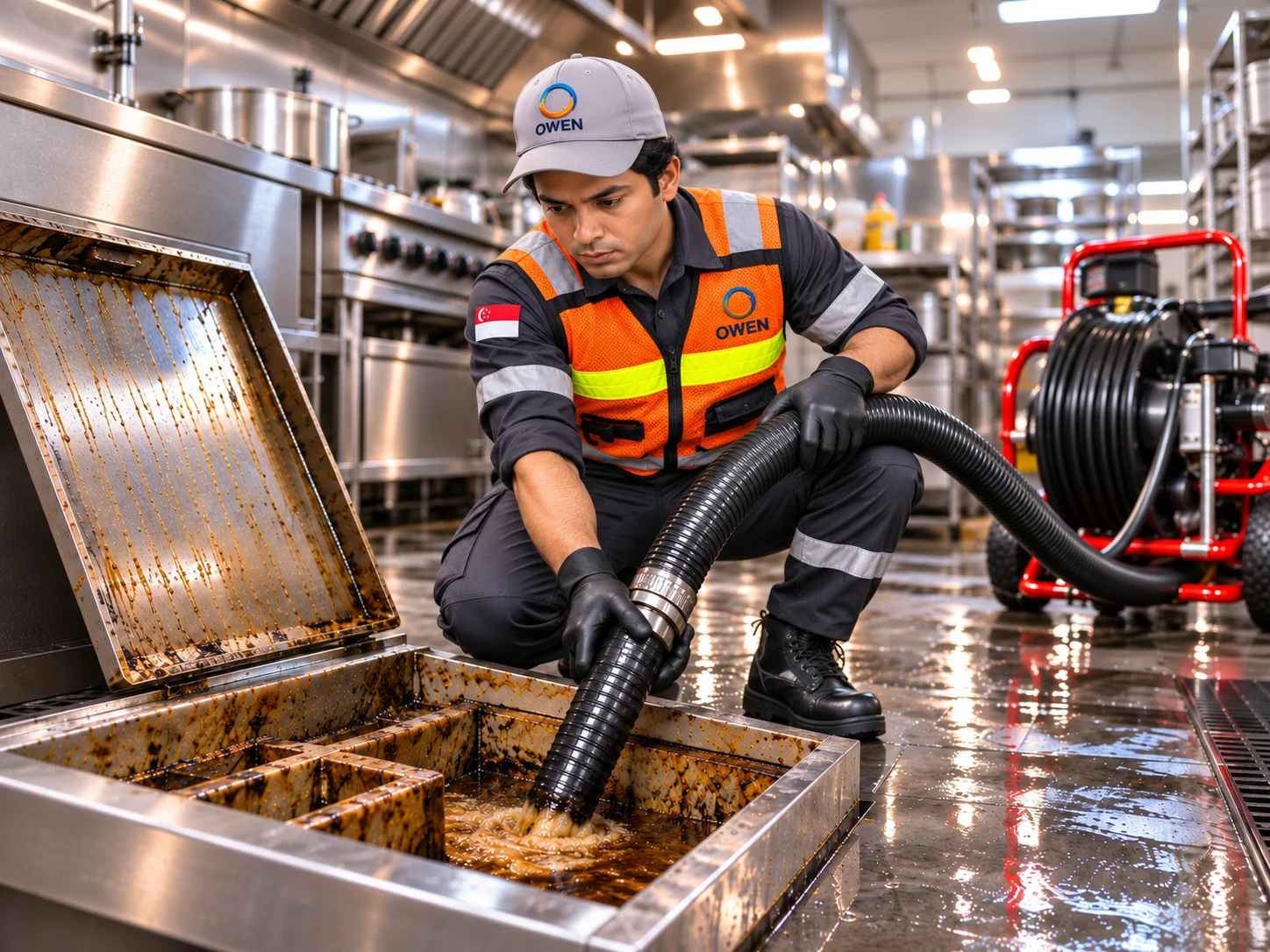
How a grease trap works inside commercial kitchens
Commercial kitchen wastewater carries heavy concentrations of fats, oils, and grease (FOG) alongside solid food particles. A grease trap (grease interceptor) slows down the wastewater flow, allowing buoyancy separation to take place: dense food solids settle to the bottom, while lighter fats and grease float to the surface.
Separated greywater exits beneath an internal baffle into the public sewerage system. However, if the trap is neglected and allowed to accumulate excess waste, solidified grease escapes under the baffles, leading to severe sewer stack blockages, foul kitchen odors, and heavy NEA regulatory fines.
Key Capabilities & Standards
- Physical gravity separation: floating grease cake on top, settled food sludge at the bottom
- Internal baffles and strainer baskets prevent solid fats escaping into public sewers
- Protects commercial kitchen floor traps, sinks, and vertical sanitary stacks
- Essential compliance requirement for NEA food shop licensing in Singapore
Singapore maintenance regulations & frequencies
The Public Utilities Board (PUB) and National Environment Agency (NEA) enforce strict grease interceptor standards. PUB officially recommends that food establishments clean their grease traps at least once every two weeks (fortnightly), with higher frequencies required for high-volume kitchens.
All collected grease trap waste must be extracted and transported by an NEA-licensed General Waste Collector (Class C). Disposal records must be retained on site for regulatory inspection.
Key Capabilities & Standards
- PUB recommends grease trap cleaning at least once every two weeks for food establishments
- Mandatory waste disposal through NEA-licensed General Waste Collectors
- Private sewer flushing recommended at least once every 6 months for F&B premises
- Service logs and disposal receipts must be maintained on site for NEA audits
Seven-stage professional cleaning workflow
Stage 1: Review trap and records. We inspect location, capacity, kitchen operating hours, historical choke records, and check for overflow or foul odors.
Stage 2: Secure kitchen work area. Service is scheduled during kitchen downtime; food preparation counters are protected, and anti-slip mats are placed around the work area.
Stage 3: Open and assess. Safely lift the cover, inspect grease blanket thickness, sludge depth, baffle conditions, and check inlet/outlet seals.
Stage 4: Complete waste extraction. Our technicians extract the entire waste load—both floating grease and bottom sludge—rather than merely skimming surface fats.
Key Capabilities & Standards
- Scheduled during kitchen downtime to eliminate food contamination risks
- Complete removal of floating grease blanket and settled bottom food solids
- Surface skimming alone is rejected; full volumetric pump-out is standard
- Odor containment and clean work zone isolation throughout extraction
Internal washdown, resealing & licensed disposal
Stage 5: Clean internal parts and surfaces. Scrape and wash chamber walls, baffle plates, and strainer baskets. Greasy washdown residue is contained and removed rather than washed down the outlet.
Stage 6: Inspect, close and test. Check for corroded covers, damaged baffles, or failed rubber gaskets. The cover is reseated airtightly and wastewater discharge is verified.
Stage 7: Licensed disposal & log maintenance. Waste is transported by licensed collectors, and official maintenance logs are updated for regulatory inspection.
Key Capabilities & Standards
- Thorough mechanical scraping of internal baffle plates and chamber walls
- Airtight lid reseating prevents kitchen odors and pest infestation
- Discharge verification ensures clean flow through the outlet baffle
- Complete NEA-compliant service documentation for licensing renewal
Enzyme dosing vs physical pump-out
Some contractors promote chemical or enzyme dosing as a standalone alternative to cleaning. While bio-enzymes can assist in breaking down surface grease between scheduled visits, they cannot digest mineral solids or replace physical pump-out requirements.
PUB and NEA guidelines mandate regular physical cleaning and licensed waste extraction. Relying solely on enzyme dosing can lead to emulsified grease hardening downstream, resulting in catastrophic main sewer failures.
Key Capabilities & Standards
- Enzyme dosing is a supplementary aid, never a substitute for physical extraction
- Emulsified fats can re-solidify downstream, causing deep sewer stack blockages
- Physical extraction removes heavy food sludge that biological enzymes cannot digest
- Complies fully with statutory requirements for commercial F&B operations
Frequently asked questions
How often should a food establishment clean its grease trap?
PUB recommends cleaning at least once every two weeks for food establishments, with more frequent visits where cooking grease volume is heavy. Actual frequency must match kitchen loading to prevent downstream overflow.
Will cleaning the kitchen drain solve an overflowing grease trap?
Not by itself. If the trap is full, the entire contents must be pumped out and internal baffles cleaned. A downstream blockage may also require independent hydro jetting or CCTV inspection.
Can enzyme dosing replace physical grease trap cleaning?
No. Enzyme and bacterial dosing products can help control odors and soften surface grease, but they cannot replace the physical pump-out and licensed waste disposal mandated by Singapore environmental regulations.
Discuss your site with Owen
Share the location, the symptoms and any access restrictions. Our team can help clarify the next step and the scope of work.