What actually happens inside the pipe?
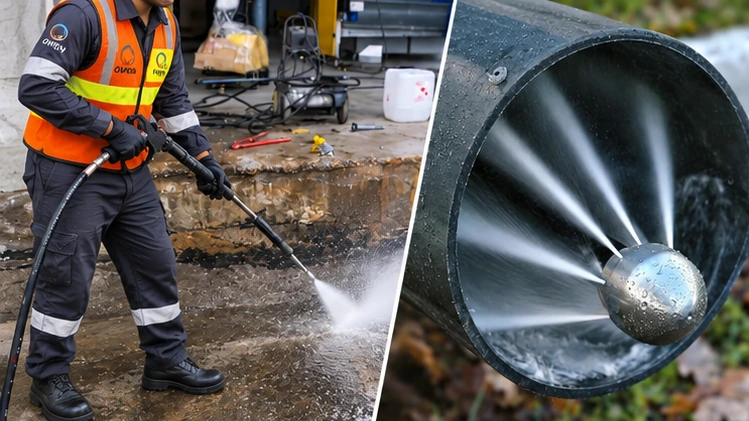
Water travels through a reinforced high-pressure hose to a purpose-designed nozzle. Forward-directed water jets penetrate and pierce dense blockages, while rear-facing jets propel the nozzle autonomously through the pipe while sweeping dislodged debris back toward an accessible collection point.
A separate multi-direction rotary cleaning head washes residue around the full 360-degree pipe circumference. Nozzle geometry and pressure are calibrated for the actual pipe size, material, age, and blockage type rather than simply running at maximum pressure.
Key Capabilities & Standards
- Forward penetrating jets pierce solid grease plugs, silt cakes, and compacted debris
- Rearward propulsion jets drive the hose through bends while sweeping loosened waste backward
- 360° rotating scouring heads strip grease film and mineral scale flush with the pipe wall
- Pressure and flow rate calibrated to pipe material (cast iron, PVC, HDPE, vitrified clay)
Suitable applications across properties
Mechanical clearing can restore movement through an immediate choke, but hydro jetting is designed to wash away accumulated residue along the full length of the conduit. The result is a cleaner drainage route that prevents rapid re-choking.
Hydro jetting is the preferred solution across residential estates, condominiums, commercial shopping centers, industrial facilities, and F&B establishments.
Key Capabilities & Standards
- Fats, oils, and grease (FOG) removal in commercial kitchen waste and sewer lines
- Sludge, silt, and sediment flushing in stormwater, culvert, and external drainage lines
- Mineral scale and calcified encrustations reducing effective internal pipe diameter
- Preventive maintenance cleaning for condos, central kitchens, hotels, and factories
- Eliminating chronic recurring chokes that return shortly after mechanical rodding
Seven-stage professional jetting workflow
Stage 1: Assess complaint & pipe condition. Identify recurring symptoms, accessible chambers, pipe diameter, structural stability, and safe discharge routes. CCTV is deployed first if cracks or collapse are suspected.
Stage 2: Entry point & downstream capture. Open cleanouts or inspection chambers, cordon work zones, and plan how dislodged sludge will be captured rather than washed into another restriction.
Stage 3: Select nozzle & controlled settings. Penetrating heads open obstructions; rotating or chain-flail heads scour pipe walls. Pressure is tuned to site conditions.
Key Capabilities & Standards
- Thorough pre-inspection and risk assessment before pressurizing lines
- Downstream chamber containment prevents debris washing into municipal sewers
- Engineered nozzle profiles selected for specific obstruction types
- Variable pressure control prevents structural stress on older pipe materials
Hose progression, collection & verification
Stage 4: Introduce hose with controlled flow. The nozzle is fed into the pipe while operating pressure is increased progressively under trained operator control.
Stage 5: Break through and clean the full run. The operator works through the affected length, using rear-facing jets to move dislodged material back while rinsing pipe walls.
Stage 6: Collect debris & check downstream drainage. Heavy silt, grease, and settled waste are extracted from receiving chambers via vacuum suction.
Stage 7: Verify the result. Flow checks and optional post-clean CCTV confirm clean walls and reveal any structural defects previously hidden by deposits.
Key Capabilities & Standards
- Systematic forward passes and controlled tension retrieval ensure thorough cleaning
- Vacuum extraction captures dislodged solids directly from downstream chambers
- Post-jetting flow tests verify unrestricted gravitational discharge velocity
- Optional CCTV inspection provides undeniable visual proof of clean pipe walls
What jetting does not repair
While hydro jetting is exceptionally effective at scouring grease, sludge, and scale, it is not a repair method for structurally broken pipes. Collapsed conduits, displaced joints, severe root re-entry through cracked sockets, or large non-dispersible foreign items require specialized retrieval or pipe rehabilitation.
Where structural faults are uncovered during jetting, our team provides objective repair advice, including localized trenchless relining or sectional pipe replacement.
Key Capabilities & Standards
- Cannot repair collapsed, displaced, or severely cracked pipework
- Non-dispersible objects (concrete slurry, heavy metals) require physical retrieval
- CCTV inspection recommended when structural integrity remains uncertain
- PUB-licensed sanitary guidance provided for necessary permanent pipe repairs
Frequently asked questions
What can high-pressure jetting remove?
Jetting removes grease, sludge, silt, food solids, organic debris and light mineral scale. Results depend on deposit hardness and pipe condition; rigid foreign objects or damaged pipes require mechanical retrieval or structural repair.
Does jetting use hazardous chemicals?
No. The core method relies entirely on pure pressurized water and engineered nozzle dynamics. No corrosive acids or toxic chemical reagents are introduced into your drainage system.
Is jetting suitable for older pipes?
Yes, provided operating pressures are calibrated responsibly. Fragile, aged, or cracked pipework requires careful assessment and pressure tuning to ensure safe, effective cleaning without joint damage.
Discuss your site with Owen
Share the location, the symptoms and any access restrictions. Our team can help clarify the next step and the scope of work.