
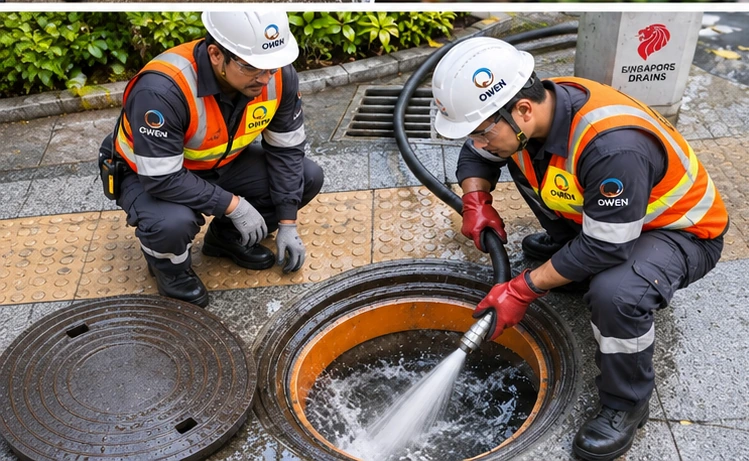
How flushing differs from emergency choke clearing
Emergency clearing addresses an acute localized choke so wastewater can immediately pass. In contrast, planned sewer and drain flushing evaluates an entire drainage network—connected pipe runs, inspection chambers, stormwater culverts, and sump connections—removing accumulated sediment along the whole route.
By thoroughly clearing sediment, sand, grease cakes, and bio-sludge from interconnected conduits, scheduled flushing prevents the slow reduction of hydraulic capacity that leads to sudden estate-wide back-flooding during heavy tropical downpours.
Key Capabilities & Standards
- Clears entire interconnected sewer and stormwater networks, not just single chokes
- Removes heavy sand, gravel, and silt deposited during construction or monsoon rains
- Restores gravitational flow gradients across multi-chamber drainage runs
- Combines high-volume water flushing with downstream vacuum extraction
Main situations requiring network flushing
Sediment accumulation is common across external drains, car parks, industrial estates, and commercial facilities. Without regular maintenance, sediment hardens into compacted layers that severely reduce flow cross-section.
Our flushing teams deploy high-volume jetting and suction equipment tailored to residential estates, commercial developments, and industrial sites across Singapore.
Key Capabilities & Standards
- Heavy sand and silt deposition in external storm drains, perimeter scupper drains, and sumps
- Grease and organic sludge build-up along connected commercial sewer networks
- Reduced drainage capacity causing rainwater back-pooling during heavy Singapore rains
- Post-construction sediment removal before building inspection and authority handover
- Routine preventive flushing for condominium estates, logistics hubs, and factories
Seven-stage professional flushing workflow
Stage 1: Plan the drainage route. Identify upstream and downstream chambers, conduit directions, gradient falls, discharge outlets, traffic controls, and available water supply points.
Stage 2: Pre-inspect and isolate. Inspect chambers, screens, and gratings. Verify whether older or fragile pipe sections require camera inspection before applying high water volumes.
Stage 3: Remove large accumulations. Safely remove bulky debris or use vacuum suction to clear settled silt in receiving chambers before sending flushing volume through.
Key Capabilities & Standards
- Complete pipeline mapping and downstream discharge route identification
- Chamber inspection and assessment of structural pipe integrity
- Heavy silt and solid debris removed from receiving chambers prior to flushing
- Traffic management and pedestrian safety barriers placed around access manholes
Sectional flushing, waste capture & verification
Stage 4: Flush or jet by section. Introduce controlled water flow through the accessible line using nozzles matched to pipe diameter, working systematically across mapped segments.
Stage 5: Capture displaced waste. Heavy sediment and sludge are extracted from downstream chambers using vacuum suction, preventing debris transfer into public municipal sewers.
Stage 6: Check outlets and connections. Inspect receiving chambers, outfalls, and sumps for residual silt or abnormal pooling, testing flow under normal operating conditions.
Stage 7: Record and plan next cycle. Note sections flushed, volume of sediment recovered, and recommend CCTV or physical repairs for recurring low-flow zones.
Key Capabilities & Standards
- Systematic section-by-section flushing ensures no segments are missed
- Simultaneous vacuum capture prevents debris settling in downstream chambers
- Hydraulic flow checks confirm full gravitational fall into municipal sewers
- Maintenance logs and defect reports delivered for estate record-keeping
Important cautions & network limitations
Flushing restores capacity lost to sediment and debris, but it cannot resolve underlying structural defects, reverse pipe gradients (backfalls), damaged pump stations, or municipal main line capacity bottlenecks.
Where persistent standing water or structural defects are observed during flushing, our engineers provide diagnostic CCTV footage and clear recommendations for localized repair or gradient correction.
Key Capabilities & Standards
- Flushing does not correct structural pipe collapse or reversed pipe gradients
- Proper waste capture is mandatory to prevent environmental contamination
- CCTV inspection recommended when lines show persistent standing water
- Professional civil engineering advice provided for long-term drainage remediation
Frequently asked questions
Is drain flushing the same as high-pressure jetting?
Flushing describes the comprehensive network-cleaning objective. High-pressure water jetting is a primary tool used to scour pipe walls; chamber silt clearing and vacuum extraction complement complete flushing.
Can flushing stop recurring flooding during heavy rain?
Flushing restores drainage capacity lost to accumulated sediment and debris. However, flooding caused by undersized system design, structural pipe collapse, or tidal backflow requires separate engineering diagnosis.
Do you need a vacuum tanker for drain flushing?
Not always, but a vacuum tanker is highly recommended when large volumes of heavy sand, silt, or sludge must be extracted from receiving chambers rather than washed downstream into public sewers.
Discuss your site with Owen
Share the location, the symptoms and any access restrictions. Our team can help clarify the next step and the scope of work.